





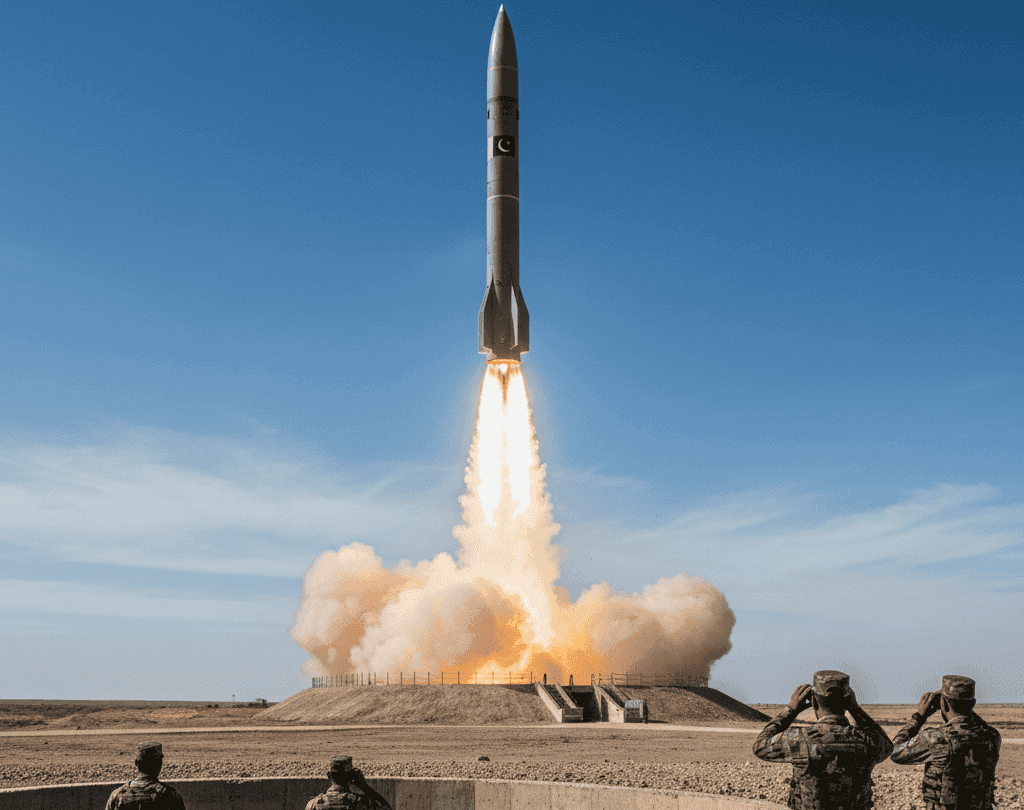
Pakistan Fatah 4 missile has officially entered the spotlight as the country successfully conducted its test fire in 2025. This long range cruise missile represents one of the most advanced developments in Pakistan’s defense program and highlights the nation’s efforts to maintain credible deterrence in a rapidly shifting regional security environment.
Introduction of Pakistan Fatah 4 missile
The Pakistan Fatah 4 missile has been designed to meet modern warfare requirements. With a range of about 750 kilometers, the missile can strike precise targets and avoid detection through low altitude flight paths. The Inter Services Public Relations (ISPR) confirmed that the test was witnessed by senior officials and scientists who celebrated the success as a milestone in indigenous defense technology.
According to reports, the Pakistan Fatah 4 missile carries modern avionics, navigation systems, and guidance mechanisms that allow high accuracy. It is a cruise missile that reflects Pakistan’s commitment to peace but also to protecting its sovereignty.
Strategic Importance of Pakistan Fatah 4 missile
Defense analysts argue that the Pakistan Fatah 4 missile strengthens the country’s second strike capability. In South Asia, where neighboring states are constantly modernizing their arsenals, the presence of a long range cruise missile adds balance. Analysts believe that this test ensures Pakistan’s ability to deter aggression while maintaining a defensive policy.
A senior retired military official stated that the Fatah 4 is not just about firepower but about credibility. It signals that Pakistan is capable of responding to challenges with modern technology, keeping pace with regional developments.
Regional Context and Comparisons
The regional context makes this missile test even more significant. India has been working on advanced ballistic and cruise missile systems, including the Agni V and BrahMos programs. In such an environment, the Pakistan Fatah 4 missile test is widely seen as a counterbalance to maintain deterrence.
Experts at the South Asia Strategic Stability Institute pointed out that such developments reduce the risk of miscalculation by ensuring that both sides recognize each other’s capabilities. While critics say these advancements add to the arms race, others argue that deterrence is the only path to stability in the region.
Official Reactions
Prime Minister Shehbaz Sharif congratulated the scientists and armed forces, calling the success of the Pakistan Fatah 4 missile a landmark moment. He emphasized that Pakistan seeks peace but cannot compromise on defense. Similarly, the President stated that this achievement is proof of the talent and dedication of the nation’s researchers and engineers.
The military stressed that Pakistan’s policy remains defensive in nature. Officials explained that while the missile enhances deterrence, it is not aimed at aggression but at preserving sovereignty and stability.
International Observations
Global think tanks and media outlets have closely followed the Pakistan Fatah 4 missile test. The Carnegie Endowment and International Institute for Strategic Studies noted that Pakistan continues to expand its cruise missile capabilities while keeping its program transparent enough to avoid international sanctions.
Western experts highlighted that missile modernization is a natural step for countries facing security threats. They also raised concerns that continued tests in South Asia could further fuel an arms race, but acknowledged that Pakistan’s program remains consistent with its stated policy of minimum credible deterrence.
Indigenous Development and Future Outlook
Another key aspect of the Pakistan Fatah 4 missile is its indigenous development. Pakistan has been focusing on reducing dependency on foreign suppliers by investing in local defense research and production. By developing the Fatah series locally, Pakistan is building capacity not only in defense but also in science and technology.
Looking ahead, analysts expect the Pakistan Fatah 4 missile to be inducted into the strategic forces command, strengthening operational readiness. Future versions may include extended ranges and even more sophisticated guidance systems.
Conclusion
The Pakistan Fatah 4 missile test in 2025 marks an important milestone in the country’s defense strategy. With its advanced technology, precise targeting, and strategic significance, the missile reflects Pakistan’s determination to maintain peace through strength. While international observers debate the implications, one fact remains clear: the Pakistan Fatah 4 missile has reinforced the country’s position as a responsible power with credible deterrence.